Flooring guides · Luxury vinyl
Take a closer look at the edges.
Colour catches your eye. Thickness and wear layer make the shortlist. But the small connection along the edge of a vinyl plank deserves a look too.
Here’s how the main locking approaches work, and what to ask before choosing your floor.
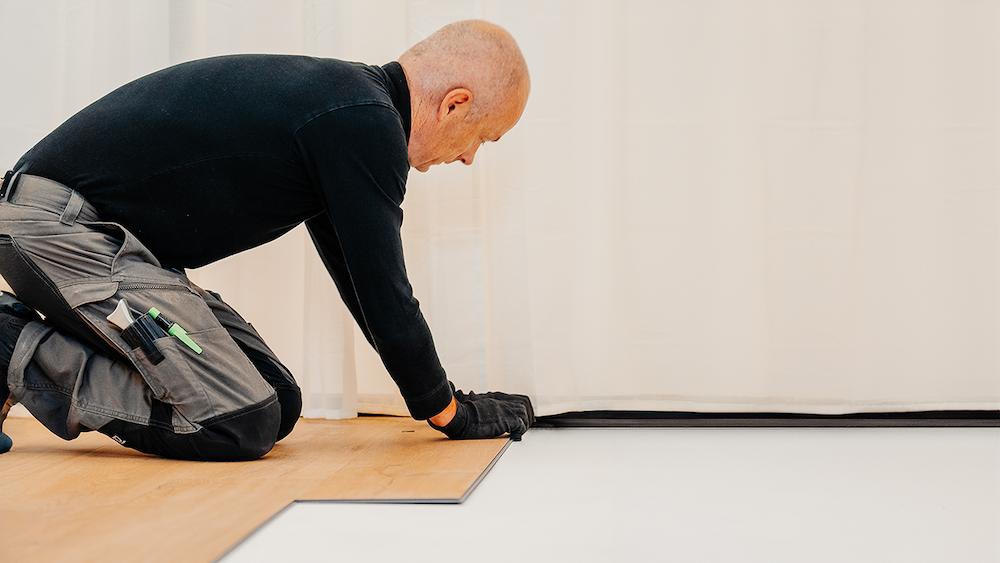
“Click-lock” is only the starting description.
A plank has a long edge and a short end. Depending on the product, those edges may engage using different movements.
The long edge often connects by inserting one plank at an angle and lowering it. At the short end, the connection may involve angling, horizontal tapping or a downward movement. That difference becomes much clearer when you handle two samples.
A name worth asking about: “double click” is not a sufficiently precise installation instruction. Ask the supplier to demonstrate the long edge and short end, and check the manual for that collection.
Angle and angle-tap
Example: Uniclic
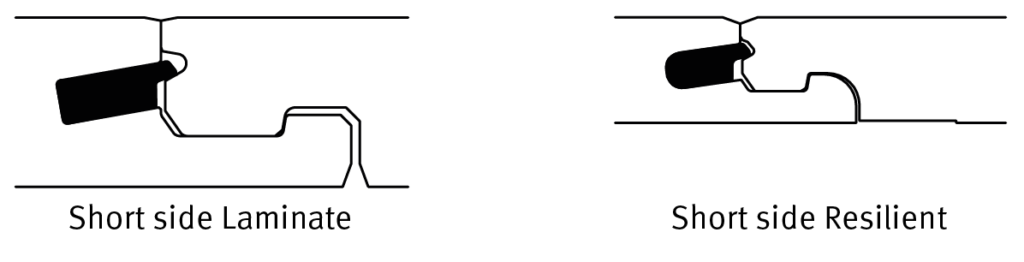
Uniclic supports angular installation and can also connect through horizontal tapping. That alternative can be useful where there isn’t much room to lift a plank, such as beneath a door frame.
The joint is formed in the plank’s edge profile. Unilin describes a flexible lower lip that works with the tongue as the connection engages.
Rigid-core flooring does not need to bend like a flexible sheet of vinyl. A small part of the locking profile can flex locally. Unilin’s technical information includes testing on SPC products. [1]
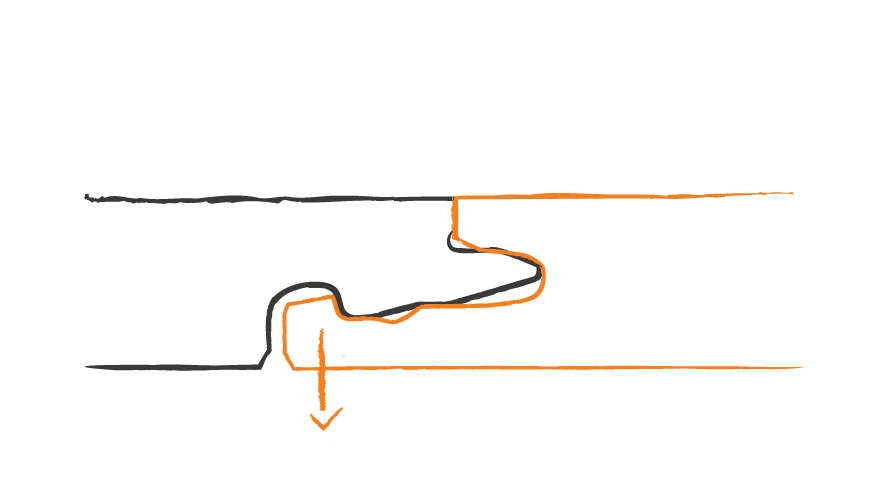
Fold-down with an insert
Example: Välinge 5G Fold Down
As the plank is lowered, a flexible insert moves into its groove. It then springs into the receiving groove to complete the connection.
Välinge describes an audible click as the insert engages. The fold-down movement is intended to simplify assembly. [2]
You still need to check the joint. A sound should not replace checking that the planks are aligned and fully seated according to the flooring manufacturer’s instructions.
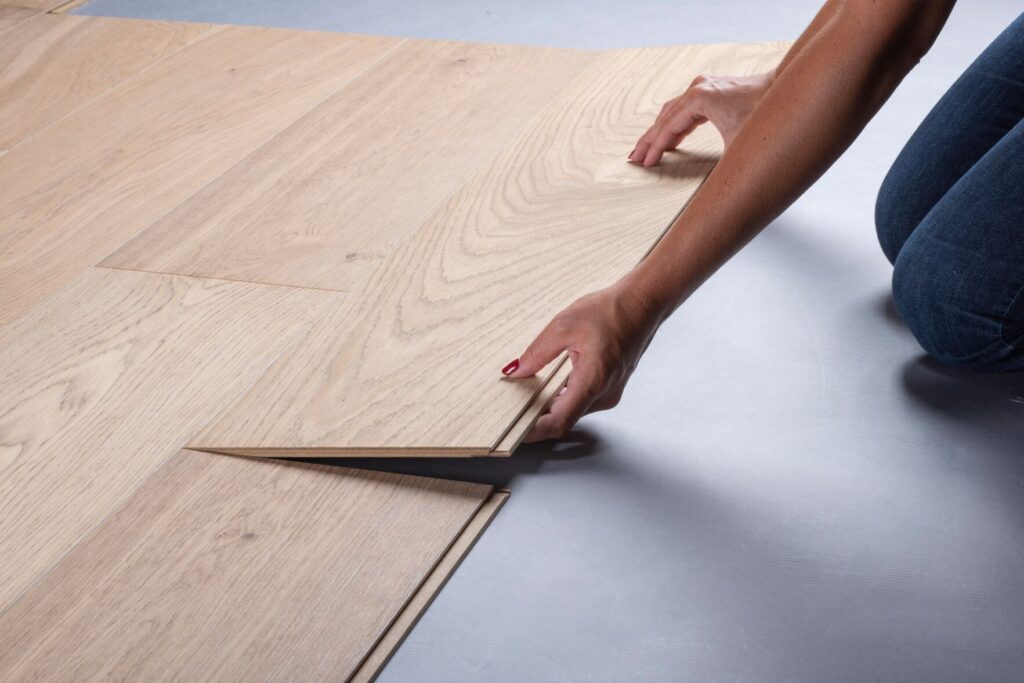
Integrated push-down
Example: Välinge 5G-i
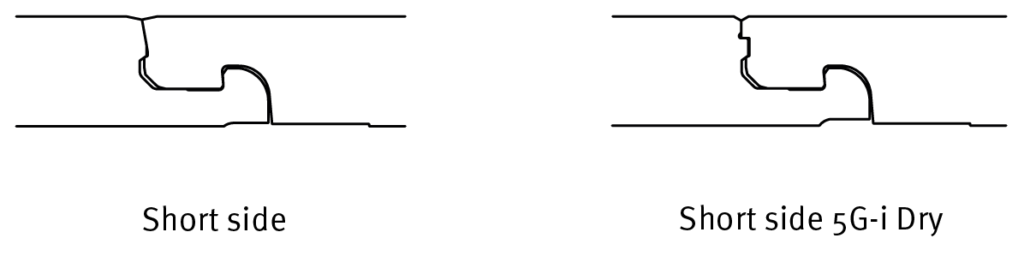
Not every downward-locking system contains a separate insert. In 5G-i, the locking element is integrated into the plank’s core.
The long edge is angled into position, followed by a downward movement at the end joint. Välinge describes using a soft mallet to secure the connection. The integrated strip flexes during engagement and returns into position. [3]
Although their names look similar, 5G Fold Down and 5G-i are different designs.
Compare the connection.
| Approach | Connection | What to check |
|---|---|---|
| Angle / angle-tap | Angular engagement; some profiles also allow horizontal tapping | The approved method and tools for that product |
| Insert-based fold-down | Downward assembly engages a separate flexible insert | Full seating and alignment of the joint |
| Integrated push-down | Downward assembly engages an element formed in the core | Specified pressing or tapping method |
These are broad descriptions, not instructions for installing a particular floor. The long-edge connection may differ from the short-end connection.
Does one type make a better floor?
There isn’t a reliable shortcut that ranks every floor by its locking-system name. The profile is one part of the product. The material surrounding it, the accuracy of the machining and the condition of the edges deserve attention too.
A joint must be assembled using the method intended for that flooring. If a plank is difficult to connect, stop and check alignment, debris and possible damage rather than simply applying more force.
Be cautious with claims such as “all drop locks are weak” or “this system is always stronger.” A useful strength comparison needs information about the actual products and the conditions under which they were tested.
Faster assembly isn’t the whole job.
A convenient connection can make laying the planks quicker. Whether it changes the total installation cost is a separate question.
Subfloor preparation, moisture checks, layout, cuts and transitions still take time. A room with several doorways and awkward cuts is a different job from a large open space.
If installation speed is part of the sales pitch, ask what is being compared. A percentage saving on plank assembly does not automatically mean the same saving on the entire project.
Try this with two samples.
Ask for a demonstration and use this checklist while you compare. You can tick the questions as you go.
A few common questions.
Are 5G and 5G-i the same?
No. The 5G Fold Down example described here uses a separate flexible insert. The 5G-i example has a locking element integrated into the core. Check the exact product documentation.
Does every drop lock use a plastic insert?
No. “Drop lock” is a broad description of an assembly movement. Both insert-based and integrated designs exist.
Does “click-lock” mean the floor is waterproof?
The locking description alone does not establish a water-performance claim. Check the product’s written specifications and water warranty.
Can I install a similar-looking plank using the same method?
Do not assume so. Similar-looking joints can have different installation requirements. Use the instructions for the exact flooring collection.
See the connection in person.
Bring your measurements and preferred colours to The Floor Hut. Ask to see how the available samples connect, then discuss the requirements for your space.
About the images: Manufacturer photos and profile illustrations are credited to Unilin Technologies and Välinge Innovation. They explain the technologies shown and do not identify the locking system on any specific product sold by The Floor Hut. Always follow the installation instructions and warranty for the actual collection.
Technical reading
Read about luxury vinyl construction → · All flooring guides →